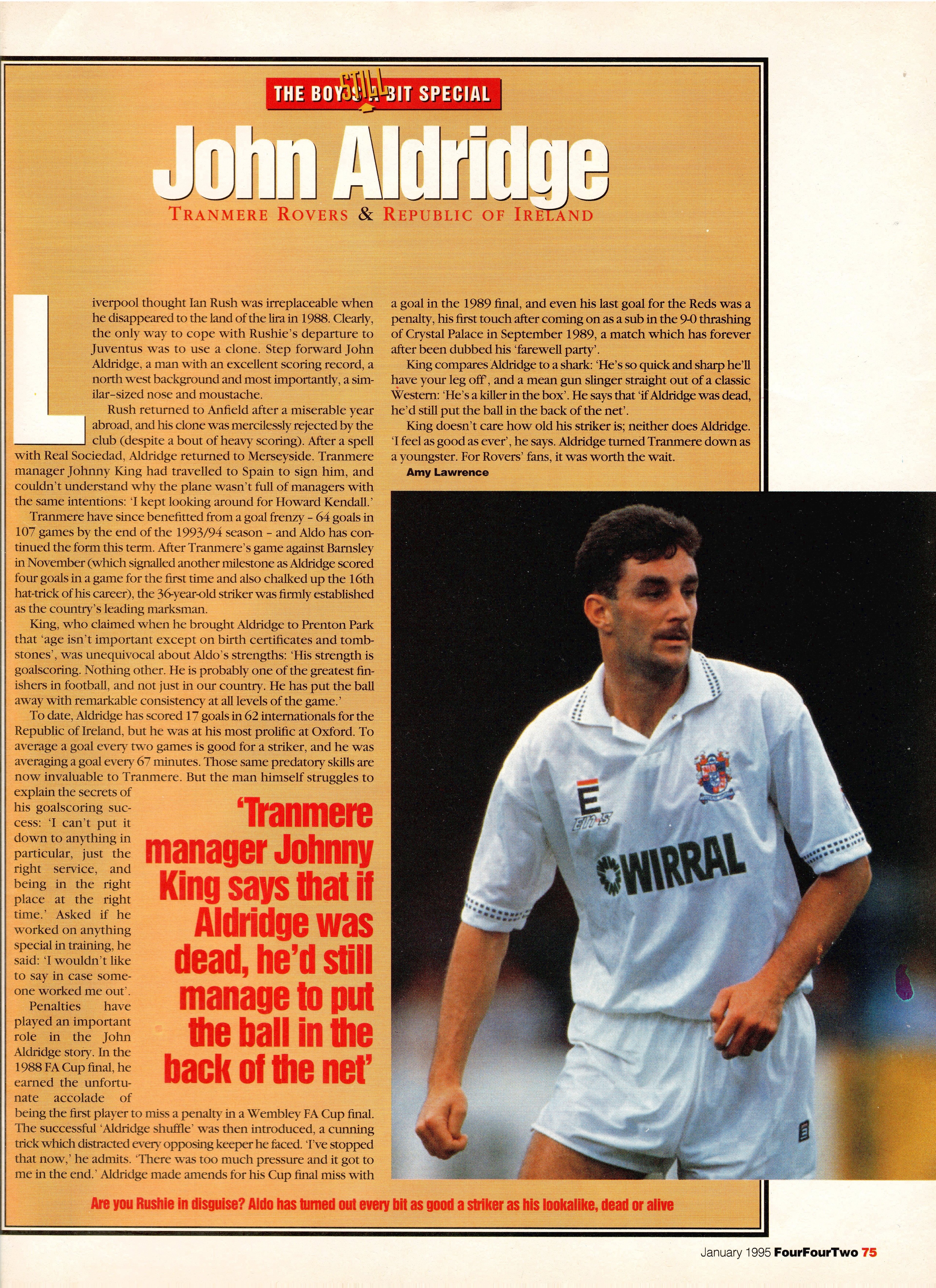
Liverpool thought Ian Rush was irreplaceable when he disappeared to the land of the lira in 1988. Clearly, the only way to cope with Rushie’s departure to Juventus was to use a clone. Step forward John Aldridge, a man with an excellent scoring record, a north-west background and, most importantly, a similar-sized nose and moustache.
Rush returned to Anfield after a miserable year abroad, and his clone was mercilessly rejected by the club (despite a bout of heavy scoring). After a spell with Real Sociedad, Aldridge returned to Merseyside. Tranmere manager Johnny King had travelled to Spain to sign him, and couldn’t understand why the plane wasn’t full of managers with the same intentions: “I kept looking around for Howard Kendall.”
Tranmere have since benefited from a goal frenzy — 64 goals in 107 games by the end of the 1993/94 season — and Aldo has continued the form this term. After Tranmere’s game against Barnsley in November (which signalled another milestone as Aldridge scored four goals in a game for the first time and also chalked up the 16th hat-trick of his career), the 36-year-old striker was firmly established as the country’s leading marksman.
King, who claimed what he brought Aldridge to Prenton Park that “age isn’t important except on birth certificates and tombstones”, was unequivocal about Aldo’s strengths: “His strength is goalscoring. Nothing other. He is probably one of the greatest finishers in football, and not just in our country. He has put the ball away with remarkable consistency at all levels of the game.”
To date, Aldridge has scored 17 goals in 62 internationals for the Republic of Ireland, but he was at his most prolific at Oxford. To average a goal every two games is good for a striker, and he was averaging a goal every 67 minutes. Those same predatory skills are now invaluable to Tranmere. But the man himself struggles to explain the secrets of his goalscoring success: “I can’t put it down to anything in particular, just the right service, and being in the right place at the right time. Asked if he worked on anything special in training, he said: ‘I wouldn’t like to say in case someone worked me out’.”
Penalties have played an important role in the John Aldridge story. In the 1988 FA Cup Cup final, he earned the unfortunate accolade of being the first player to miss a penalty in a Wembley FA Cup final. The successful “Aldridge shuffle” was then introduced, a cunning trick which distracted every opposing keeper he faced. (“I’ve stopped that now,” he admits. “There was too much pressure and it got to me in the end.”) Aldridge made amends for his Cup final miss with a goal in the 1989 final, and even his last goal for the Reds was a penalty, his first touch after coming on as a sub in the 9-0 thrashing of Crystal Palace in September 1989, a match which has forever after been dubbed his “farewell party”.
King compares Aldridge to a shark: “He’s so quick and sharp he’ll have your leg off,” and a mean gun slinger straight out of a classic Western: “He’s a killer in the box”. He says that “if Aldridge was dead, he’d still put the ball in the back of the net”.
King doesn’t care how old his striker is; neither does Aldridge. “I feel as good as ever”, he says. Aldridge turned Tranmere down as a youngster. For Rovers’ fans, it was worth the wait.